Retrograde Planets - an expanded view
Some key considerations
The significance and meaning of retrograde planets can be hard to grasp beyond basic expectations of energy that becomes inward focussed periodically within a planet's cycle.
This work merges astrology with the astronomical perspective to move beyond data alone to a more visual understanding that helps to further clarify why retrogrades are more important than you may think.
To enable some quick tracking and referencing some data tables are included along with visual graphics - as well as a proposal around interpretation and emphasising the concept of opportunity for growth
As the 5 outer planets are our best teachers in this regard the work begins with them.
Mars sits beyond Earth and the table and graphic demonstrate the same activation positions as Jupiter to Pluto.
Venus is used to exemplify the pattern shared with Mercury.
Jupiter to Pluto
To capture sequencing - which is meaningful - the table below begins with the cycle starting earliest in 2021 - Pluto in April and moves in sequence through to Uranus in January 2022.
Attention is paid to the unusual grouping of events in October 2021 especially the 3 stations Direct within 12 days that were the closest timeframe for multiple Direct stations found in a 150 year period 1900-2050.
Early notes were posted as tweets [Twitter @astroprofiles ] and are appended at the end for further details not added here.
The proposal contained in this data is that the square of a transit planet to Sun and Earth which precedes the retrograde station contributes the energy needed to make the internal shift that is offered during retrograde.
For this reason the sequence begins at that Eastern Quadrature location identified astronomically and astrologically as a 90 degree angle.
After Direct another square occurs in the West Quadrature location.
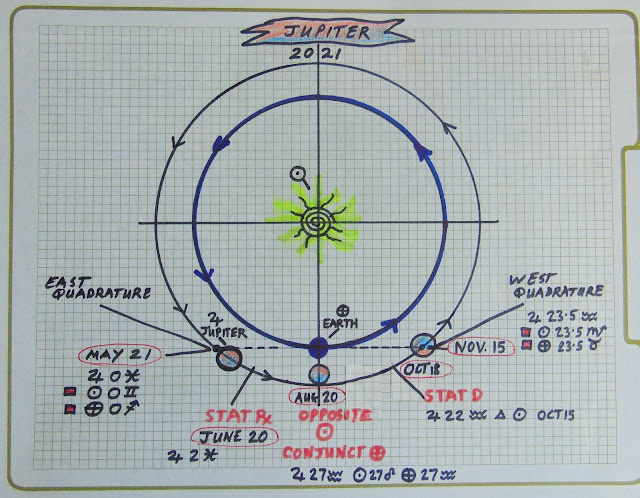
Jupiter is used as an example in the graphic view - with scale very compressed. And we know Jupiter is several orbital paths away from Earth but it is the central line of transmission from the Sun - shown here in an overhead view - which runs fully out to the orbit of Pluto that is the field of energy at the heart of the retrograde phase -sitting midway between the stations and the East and West angles.
Jupiter Saturn Uranus Neptune Pluto Retrograde Sequence April 2021-January 2022
As a grouping the sequencing being considered is 2021 into early 2022 key juncture dates beginning April 16 and ending Jan 30 2022 is by calendar month:
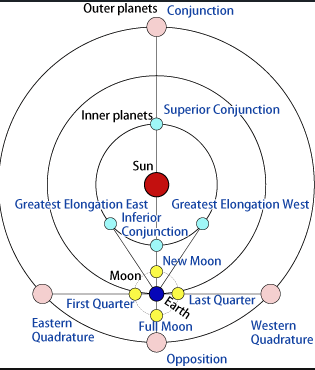
The astronomical image of an outer planet squaring Sun & Earth
Notes:
[I] Energy pile-ups within short timeframes are worth noting.
All 6 positions from first to last square are important but still rankable as per preferences
[ii] The standout month of October contains the astrological Libra within the period of all 3 direct stations noted.
January 2022 belongs significantly to Uranus - but Pluto is still ready to reinforce authority - conjuncting the Sun just as Uranus approaches exact direct Station - all of which is worth factoring into predictions
[iii] The trine has been added to this data as it is likely to help embed the consciousness gained during retrograde and always occurs in advance of the station Direct -varying from 3 days before [JUP] to 19 days before [PLU] in this sample.
It is not shown on the graphic view due to variability in timing amongst the outer planets
[iv] Data spot-checked back decades ago and far forward to mid and end of century 21 show close consistency in the timing within each sequence of these outer planets.
[v] Jupiter:
In every cycle both Jupiter Stations occur in approximate timing with trines to Sun and sextiles to Earth.
[vi] For the far outer planets the stationing or slowdown period approaching the exact retrograde position can arguably be taken from the date of the Eastern quadrature square of the transit planet to Sun-Earth.
It is common for this period before exact station R to last 10,11,12 or 13 days for Uranus-Neptune-Pluto.
For Jupiter and Saturn - the gap between square and station R is a lot longer -e.g. 30 and 23 days.
[vi] An Astronomical View gives the apparant angular relationships between different positions when considering the inferior - closest to Sun -planets Venus Jupiter and the orbit of Earth plus the orbital zone reprsented for planets Mars to Pluto.
[source ]
Interpreting
At each of the positions considered the outer planet in transit is in relationship with the Sun and Earth forming a trinity of energies creating periods when there is strong energy interaction/feedback within those 3 energy fields -as well as interaction with the signatures shown by any other transits which are not at that time in the specific retrograde sequence being observed.
This means the job of interpreting the retrograde sequence can range from simple to complex.
The point most needing to be emphasised is that the essence of a retrograde planet’s effect is imprinted or seeded during the station retrograde especially - as this period creates the energetic imprint pressured into effect as a result of the square to the Sun+ Earth which occurred between 10-30 days prior.
At exact station R another signature is formed showing how that energy has developed since the square [ pressure to re-form or reconstruct an energy expression ]- and shows the strong transmission into earth-based consciousness - not only human - into all the kingdoms of Earth and the natural elements.
The next big point of seeding occurs at the point where the outer planet is conjunct Earth/opposite Sun:
The 2021 data table for Pluto shows the opposition to the Sun occurring July 17 means Pluto was conjunct Earth during that point in the retrograde .
The retrograde transit then reaches a sextile to Earth [trine to Sun] a matter of days [JUP=3, Saturn=11 days, Uranus=17days, Neptune=19 days, Pluto=19days] before the retrograde ends.
The processing of imprinted energies is likely to be mostly or entirely subconscious during the retrograde period up to the Direct position.
The interpretation of the overall planetary energy signature(s) at the square gives vital indicators re what type of energy modulation or refinement is being created. A square has a Saturnian quality which in this context is influencing the construction or structuring of an energy.
At the retrograde opposition to Sun the planet is in conjunction to Earth and this is the midpoint of the stations - a highly energised position where the best access is available to the opportunity and meaning of the retrograde planet’s capacity to re-form this energy collectively and especially in individuals who have planetary positions in range of the degree activated in retrograde transit.
Retrogrades of the Jupiter to Pluto planets are the opportunity for individual and collective growth and evolution in consciousness.
Potentials are our capacity to take advantage of those period of opportunity - or not -over a lifetime or many lives.
The extra slow planetary pace [therefore extra strong in transmission] around stations is not connected to any earth-based visual illusion.
It is the square positions to both Earth + Sun simultaneously that slow the outer planets in preparation for the extra slow at the stations - Neptune and Pluto being the most noticeable lingerers.
A planet slows down in relationship to distance away from the Sun’s gravitational force.
With Pluto: the period approaching exact station R is preceded by the position at 90 degrees from the Sun. Here at the Eastern quadrature square we see Pluto - which naturally has a large rather slow orbit - subtly over 11 days come to an apparent pause - in 2021 around exact station R it held 26’48.3 for 5 consecutive Earth days.
A similar process occurs when approaching the Western Quadrature square: the station Direct -which has to occur first - lingered at 24’20 R from Sept 27 2021 before station on Oct 6 2021 at 24’18.7 for 3 days - taking ten days from station D to advance to 24’20. A total of 2 weeks of very slow movement [meaning=powerful effects]
Using stations as significant points in contributing to severe weather patterns I always give them this sort of wide range either side of exact station for the slower planets -see dedicated post on this site.
Ephemeris data shows outer planets are slowest in the aftermath and in the approach of square angles - i.e. the square angle to Sun-Earth sets in process the slowing down of the transit - which reaches maximum at the stations - but not at opposition to Sun-conjunction to Earth.
Astronomy of Opposition
Venus - in Comparison
Venus is a great example of an inner planet retrograde. Check timeanddate.com or the Japanese Astronomical Observatory for exact dates of the full astronomical cycle in relationship to the Sun.
This data enables a cross reference to the astrological matchups.
With Venus & Mercury there’s a similar pattern surrounding the retrograde period.
Where everything from Mars outward is triggered at the quadrature positions [ = square Sun+Earth] Mercury and Venus are activated at the semisquares to the Sun - at the Eastern and Western elongations. As in the diagram above there’s a mathematical connection between the elongation and the quadrature which can be read as following the same functional template.
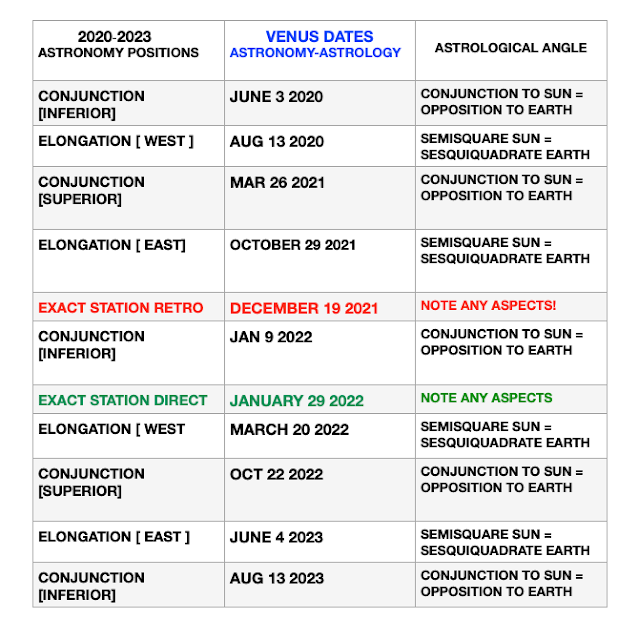
Aspects to other planets should be noticed at every stage - not just stations as these give the tone or signature to the energy being imprinted.The table below gives a larger range of Venus dates:
Every retrograde period is essentially a relationship with Earth but astronomy looking beyond Earth emphasises the relationship of the planet’s transit around the Sun at key points.
With Venus & Mercury these are the 2 elongations and the 2 conjunctions
For astrologers to get a more focussed view on planets transiting close to Earth and interpreting meaning we can look at the elongations too because a far position from the Sun means closer to Earth and this proximity increases to the point midway between the stations where - as shown - Venus is retrograde in conjunction with the Sun.
The data visual guides and more basic detail in respect of Venus [and applicable to Mercury] reinforce the premises made re the interpretation of outer planet retrogrades - highlighting the Earth-based perspective.
Note: Venus maximumum elongation is 48 degrees from the Sun but commonly closer to 45 and so equates to a semisquare at maximum distance from the Sun.
For astrologers using ephemeris data:
On Oct 29 2021 Venus reaching 23 Sagittarius having separated from the Sun approaching 6 Scorpio = this Greatest Elongation East is a 47 degree separation semisquare.
With Earth holding an opposition to the Sun the angle to Earth cannot be the same as for the Sun.
The opposing angle from Venus is a sesquiquadrate to Earth.
Astronomical positioning is often called ‘apparent” meaning where bodies in space “appear” to be when viewed from our Earthly angle.
Earth is the vantage point and intermediary orbit for the astronomical descriptions of inferior (closest to Sun) and superior [Mars outwards] orbital paths and again confirms the Goldilocks zone and qualities of our home planet in its receptivity to the whole system - inner and outer orbits as well as the influence of the luminaries. The stuff of awe and wonder in every respect.
Unfortunately two dimensional graphics are a very insufficient way of representing the co-ordinates of deep space so confusion is a given. Any corrections appreciated!
The part of the Venus cycle of most interest is the larger context surrounding the retrograde period.
The subtlest energy beginning in this data set on Oct 29 2021 at Greatest elongation East - astrologically semisquare the Sun and sesquiquadrate Earth.
Next is the exact Station Retrograde - December 19 2021.
It takes 9 weeks to reach conjunction with the Sun/opposite Earth on Jan 9 2022. Then station Direct Jan 29 2022.
The process is completed once Venus reaches maximum elongation West - March 20 2022 - giving for Venus an almost 5 month period where the work around values and relating is prepared for for during 7 weeks then internalised for processing over a 6 weeks period - and at the midpoint when Venus conjuncts the Sun it can be seen as a full-moon type relationship of Sun-Venus retrograde to Earth a time to get clarity on the deepest level of consciousness around the Venusian [Libran and Taurean] departments in your life.
Circle Jan 9 2022 on your calendar if you’re reading this before then. Next opportunity is Aug 13 2023
Venus is retrograde for 3 weeks before and after the conjunction with the Sun and the conjunction occurs midway between the 2 brief stations. The retrograde-to-direct period lasting about 42 days.
Venus and Pluto 2021-2023
Venus isn’t monogamous - more polyamorous.
What is quite fascinating about the current Venus cycle is how Venus and Pluto starting late in 2021 are having a big thing going on.
Venus in 2021 has exact retrograde on December 19 =
Venus 24 Capricorn approaches Pluto 25 Capricorn by at least Dec 8 and stays tightly bound to Pluto for almost 2 weeks before exact stationing at 26.5 Capricorn - having just passed Pluto at 25.5 Capricorn.
[Venus does not have an extra slow slowdown being so close to the Sun]
Prior to this was East elongation = October 29 2021 there was a Venus-Pluto semisextile
Looking all four points -the 2 conjunctions and 2 semisquares to the Sun plus the station R - Pluto is very connected to Venus this whole period - by conjunction square opposition sextile semisextile quincunx - and the bond between these two extending into 2023.
Then Venus spies Neptune in September 2023 at the point where the Direct station occurs - Venus 12 Leo picks up Neptune at nearly 27 Pisces [sesquiquadrate - these semi and sesqui angles aren’t “weak” ! ]
And so a range of Venus liaisons can be seen in the past and future at the critical points within the period from Eastern elongation right through to Western elongation - it just seems that this Pluto thing is especially intense and enduring in comparison. Typical.
Mars
Remember Mars complies with the outer planet pattern of forming a square at the 2 quadratures and the graphic above does show the standard astronomical lineup with a 90 degree angle formed from the quadratures to both Earth and the Sun.
The graphic shows Mars data from Feb 2021 West square to Sun+Earth to mid 2029 Direct station -followed soon by the West square and represents again the bigger time frame - when Mars comes to impact Earth -eg the period August 2022-March 2023 is a 7.5 months period being one full passage from square to square and containing the retrograde period of 3 months.
Again the retrograde conjunction to Earth/opposition to Sun occurs neatly midway between the quadratures and the 2 stations.
This NASA graphic clearly shows where Mars is when it conjuncts and opposes then Sun -and where Earth is at the same time - when Mars is in Sagittarius opposite the Sun in Gemini Mars is conjunct Earth.This doesn't happen every year due to different orbital path lengths.
The next time Mars gets close to Earth is December 2022:
Mars 16 Gemini opposite Sun 16 Sagittarius.
Dates by month supplied on the hand-drawn graphic above.
Another astronomical view combining the main orbital paths:
Retrogrades and Consciousness
Focussing on the near Earth proximity issue when a planet is retrograde has 2 fold significance: not only the matter of significance re the opportunity to receive process and thereafter utilise the enhancement of energy quality made available - but also to recognise that when a retrograde planet is midway between Stations and directly aligned to the Sun is the prime time for the trinity of Sun-Planet-Earth to undergo optimum entanglement unity fusion.
The visible everyday physics can be supplemented by a sensing or knowing the hidden quantum metaphysics.
At the simplest level it is most important to recognise the special imprint that retrogrades are capable of having on our state of consciousness or awareness.
Humans possess a dual consciousness - partly primed for the practicalities of everyday incarnation which is best activated when Direct energy is available - and partly open - to varying degrees - to the formless origin all beings have in common - the state of being an energy being - a different level of consciousness which can be labelled “spiritual” -which in itself has diverse interpretations/definitions - a non-ordinary state that people try to reach with substances -drink/drugs and other addictions - an accessible through such practices as immersion in nature and natural forces, presence, meditation, being alone.
In conclusion for now - much more can be said and done to develop this topic -and further additions made be added over time - but this is a further attempt to open up this area of enquiry to further scrutiny and understanding on a deeper level.
By merging concepts from astronomy with those from astrology more pieces of the puzzle may be constructed.
The Profiler:
Jupiter in Gemini in 1 exactly opposite Mars in Sagittarius
Pluto in Leo in 3
Mercury in Pisces in 9
Sun Pisces in 10
Uranus on South Node & trine MC
Tweets and this post written under :
The eclipse season November-December 2021.
The midpoint of the 2 eclipse positions is 4.5 mutable - natal 3/9 & ASC/DES
Transit nodes square natal Mercury
Sagittarian Sun-Mercury
Venus opposite natal Uranus
Jupiter in Aquarius in 9 trine natal Neptune
Neptune on natal MC
Pluto in natal 8 sextile Sun
Mars square natal Pluto
Saturn square Saturn
References:
Celestial Phenomena site from the Japanese Astronomical Observatory allows for local time data for planetary astronomical positions relevant to this topic:
Celestial Phenomena
Appendix:
Threaded tweets I posted from my two accounts from Nov 28-29 2021 which inspired this work
Beginning with
Then Nov 29
1. what I have learned from last night's binge scanning visually thru 150 yrs of Jupiter direct stations..take any year & locate the exact station direct
- the next statD will be 13 months ahead almost invariably.
-Jup is underestimated & not called "the second Sun" for nothing
2. Jupiter may function as the relay station for our Sun to the outer galaxy -amplifying & transmitting solar forces to our distant planets & feeding back their energy to the Sun: a fully intelligently driven system of mutual influence...
3. A deeper understanding of planetary influences is possible once you find the retro & direct stations of an outer planet - using positional astronomy.
Consider Jupiter in 2021 moving anticlockwise in the outer orbit reaching the Eastern Quadrature...
4. Jup at EQ is squ Sun & Earth = May 21 this year.This is the turning point heading towards exact station Retro June 20. Jup is now slowing and from the moving Earth perspective will seem to be reversing.
When Jup retro reaches the opposition to Sun Aug 20 it is conjunct Earth
5. Instead of thinking about retros in relationship to the Sun - for astrologers the issue is what retros do to Earth - the point of conjunction with Earth ( when the retro planet is pop Sun ) is the real story. This is where/when the seeding of energy occurs...
6. The trinity of Jup Earth & Sun is intense at the East & West Quadratures [squares] & likely strongest at the opposition/conjunction [ applying the lunation model]
Jup 2021 =
May 21 square Sun Earth
Aug 20 conj/opp '' "
Nov 15 square " "
7. ...this range of dates emphasises terrestrial impact:
exact squ to Earth
4 wks pass till Station R
exact Station R
critical conjunction to Earth
exact Direct Station
final exact squ to Earth
Content in the pinned thread explains connection to pandemic due to October phenomenon [of multiple stations Direct